
Currently Empty: ₹0.00
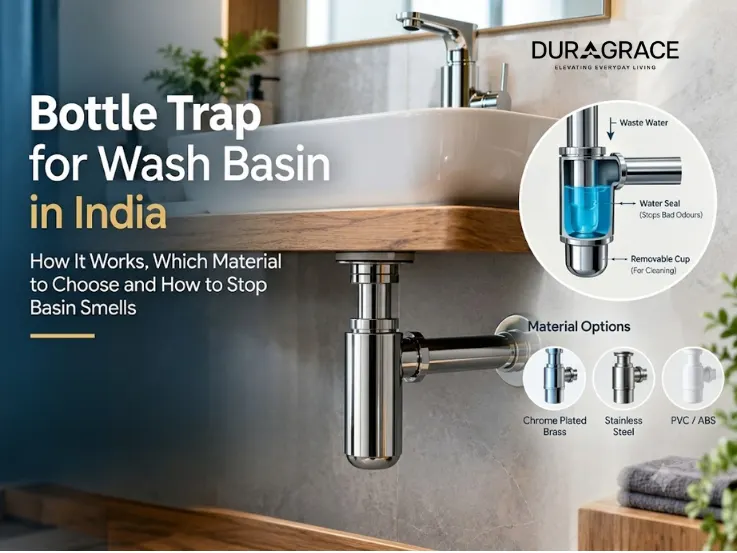
Nobody chooses a bottle trap until the bathroom starts to smell. It sits under the basin, holds a little water, and keeps the drain’s smell out of the room. When it works you forget it exists. When it fails you get odours, a slow drain or a damp cabinet.
This guide explains how a bottle trap works, how it differs from a P-trap and a waste pipe, how deep its water seal should be, which material to choose, how to measure for the right size, and how to fit and clean it. It also covers why a basin can still smell with a perfectly good trap fitted, which is usually a seal, venting or cleaning problem rather than a faulty fitting.
Quick answer: how do you choose a bottle trap?
A bottle trap is a small canister under a wash basin that holds water to block drain smells while letting waste flow out. Choose brass or stainless steel for exposed installations and PVC or ABS for hidden ones, measure the outlet and wall distance first, and clean the cup every one to three months.
Bottle trap materials at a glance
Material | Best for | Watch out for |
|---|---|---|
Chrome-plated brass | Exposed traps under floating vanities and open counters | Weight, plating dulled by harsh cleaners, thread fit |
Stainless steel | Exposed or utility installations where corrosion resistance matters | The grade (304 or 202), and the quality of joints and welds |
PVC or ABS | Traps hidden inside a cabinet, and tighter budgets | Boiling water, thin walls that crack if over-tightened |
General guidance, not specific to any one brand. Check the exact model you are buying.
What is a bottle trap, and what does it do?
A bottle trap is a drain fitting with a removable cup-shaped chamber. Waste water flows in from the basin, collects in the chamber and leaves through the outlet, always leaving some water behind. That standing water is the seal that stops drain air rising into the bathroom. It also catches hair and soap debris.
In a bottle trap, the straight waste pipe from the basin drops into a cup-shaped vessel where the water collects, which is why Hansgrohe describes it as a space-saving option for shallow basins and guest toilets (Hansgrohe trap guide). You can see DuraGrace’s range on the bottle trap collection page.
How the water seal works
Every time you drain the basin, fresh water flows through and replaces the water in the cup. The water left behind sits between the drain line and the room, so air from the drain cannot pass straight up. There is no valve and no moving part to wear out. That is why problems almost always trace to the seal itself, the joints or a blockage.
Why the seal matters
Drain air carries gases from decomposing waste, including hydrogen sulfide, which smells like rotten eggs. At household levels the problem is usually smell rather than danger, but the seal is the reason plumbing codes require a trap on each fixture. The Indian Plumbing Association describes a trap as the device that prevents sewer gas or vermin from entering the building (IPA training material).
Bottle trap vs P-trap vs waste pipe: what is the difference?
A bottle trap holds its water seal in a vertical cup, a P-trap in a U-shaped bend. Both block drain air. Bottle traps are compact and suit wall-hung or pedestal basins, while P-traps need more depth under the basin. A waste pipe, by contrast, holds no water seal at all.
Fitting | What it is | Holds a water seal? | Where it fits best |
|---|---|---|---|
Bottle trap | Cup-shaped chamber on the basin outlet | Yes | Shallow, wall-hung and pedestal basins; exposed installations |
P-trap | U-shaped bend in the pipe | Yes | Basins with enough space beneath for the bend |
Waste pipe | Straight or flexible pipe from the trap to the wall | No | Carrying water from the trap to the wall drain |
Some guides describe a bottle trap as “U-shaped”. It is not: the U-bend is a P-trap. Guides also disagree on cleaning, with some calling bottle traps harder to clean and others easier. The practical test is simple. A bottle trap whose cup unscrews by hand is quick to clean, and a P-trap with a removable bend or slip nut is too. Choose one you can open.
How deep should the water seal be?
A fixture trap should hold a water seal of at least 50 mm and no more than 100 mm, according to Indian Plumbing Association guidance. A shallow seal can be pulled out by siphonage or dry out quickly. Ask the maker for the seal depth of the exact trap you are buying.
The same material lists three ways a trap loses its seal: siphonage (water pulled out when pressure drops), back pressure (water pushed back into the basin) and evaporation. Evaporation is the one homeowners meet most often. A guest bathroom or a flat left empty for weeks can lose its seal completely, and the smell returns until water runs again.
Venting is the other half. A trap works because air pressure is equal on both sides of it, so the drainage system needs a vent. If a basin gurgles or smells when another fixture drains, suspect venting rather than the trap, and ask a plumber to check.
Most product listings do not state seal depth. That is a gap worth asking about before you buy.
Are bottle traps allowed under Indian plumbing rules?
Bottle traps are widely fitted under basins in India, but some code-based guidance treats them as a special case. The Indian Plumbing Association’s training material says drum and bottle traps should be used only where the local authority permits, and that NBC 2016 prevails in any conflict. Check on new builds.
The material is based on the Uniform Illustrated Plumbing Code and carries a disclaimer that NBC 2016 and local rules take precedence, so treat it as guidance, not law. It also lists what any trap should offer, and these make a useful buying checklist:
- A liquid seal of at least 50 mm.
- A smooth and uniform interior waterway, and a self-cleansing design.
- No moving parts that the seal depends on.
- The maker’s name marked on the trap.
- No double trapping: if the basin already has a built-in or P-trap, remove it before adding a bottle trap.
For a new build or renovation, ask your plumbing consultant or architect which trap types your local authority accepts.
Why does my basin smell even with a bottle trap?
A smelly basin usually has one of five causes: a dried-out water seal, siphonage from poor venting, a dirty cup or overflow slot, a loose washer or cracked body, or a problem further down the drain line. Run the tap first, then clean the trap, then check the seals and venting.
What you notice | Likely cause | What to do |
|---|---|---|
Smell in a rarely used bathroom | Water seal has evaporated | Run the tap for a minute; repeat every couple of weeks |
Gurgling or smell when another fixture drains | Siphonage from poor venting | Ask a plumber to check the vent |
Smell plus slow drain | Hair and sludge in the cup or pipe | Unscrew and clean the trap |
Smell near the basin rim | Slime in the overflow slot | Clean the overflow channel with a bottle brush |
Drip, damp patch and smell | Loose joint, worn washer or cracked body | Re-seat or replace the washer, replace a cracked body |
Smell persists after all of the above | Fault beyond the trap in the drain line | Call a plumber |
Hansgrohe’s advice matches the first step: if no fresh water has run through a drain for a long time, running the tap for longer displaces the old trap water and the smell often disappears.
Brass, stainless steel or PVC: which bottle trap material should you choose?
Brass and stainless steel suit exposed installations because they are rigid and look finished. PVC and ABS are lighter and cheaper, and sensible when the trap is hidden inside a cabinet. Whatever the material, check thread quality, wall thickness and washer fit, because those decide whether joints stay leak-free.
Hidden or exposed? If the trap sits inside a closed vanity, nobody sees it, so function and price can lead. Under a floating vanity or a pedestal basin it is part of the design, so a metal trap in a matching finish is worth the extra cost.
Stainless steel grade. “Stainless steel” alone is not a specification. Ask for grade 304, and see our guide to SS 304 vs SS 202 for how to tell them apart.
Hot water. Very hot or boiling water can soften PVC, so avoid pouring it down a plastic trap. If the basin takes hot water straight from a geyser, ask the maker whether a heat-rated material or a metal trap is recommended.
Thin walls. Thin plastic flexes under a wrench and can crack at the thread. Brass and steel tolerate firm tightening, but over-tightening any trap damages the washer seat.
Smooth-bore or corrugated: which outlet pipe is better?
A smooth-bore trap and outlet pipe let hair and soap scum slide through. Corrugated flexible pipes have ridges inside where debris can catch, and they can sag into low spots that hold sludge. Use flexible pipe only where alignment demands it, and keep it short and supported.
The Indian Plumbing Association guidance asks for a smooth and uniform interior waterway in every trap, and that applies in spirit to the pipe that follows it. A rigid or smooth pipe is the better default. A flexible pipe earns its place when the basin outlet and the wall drain do not line up, so choose a heavy, reinforced one and make sure it cannot droop. DuraGrace lists flexible waste pipes and bottle trap pipes in its plumbing range.
How do you choose the right size and length?
Measure three things before buying: the basin outlet size, the horizontal distance to the wall waste pipe and the vertical drop from the basin outlet to the trap. Many basin outlets in India are 32 mm, but older ones can differ. Keep the drop short and leave room to unscrew the cup.
- Basin outlet. Measure the diameter of the waste outlet on the basin. Do not assume 32 mm.
- Horizontal reach. Measure from the basin outlet to the wall waste pipe. This sets the pipe length you need.
- Vertical drop. Measure from the basin outlet down to where the trap will sit. Keep it as short as practical. The IPA guidance caps a basin tailpiece at 600 mm.
- Access. Leave enough clear space below the cup to unscrew it and slide it out with a small bucket underneath.
- Package contents. Confirm whether the listing is a complete set or only the trap. Pipe, wall flange and basin waste coupling are often sold separately.
For the basin outlet joint, DuraGrace lists waste couplings separately from the trap.
How do you install a bottle trap?
Fit the basin waste first, attach the trap with every washer seated flat, connect the outlet pipe without forcing it at an angle, then tighten by hand plus a small final turn. Fill the basin and release it suddenly to test for drips. Leave enough space below to remove the cup.
- Place a bucket under the old trap and remove it, tipping out the residual water.
- Fit the basin waste or coupling with its gasket so it is seated flat on the basin.
- Check the new trap for its washers. Each joint should have one, sitting square.
- Attach the trap body to the basin waste and tighten by hand.
- Connect the outlet pipe to the wall fitting, aligned so no joint is under strain.
- Give each joint a final small turn with a wrench. Plastic needs far less force than metal.
- Fill the basin, then let it drain suddenly. A dry joint means a good seal; a drip means re-seat the washer.
- Check that the cup can still be unscrewed by hand.
Two cautions. First, advice on thread tape differs: some installers add PTFE tape, but many basin joints seal on a washer instead, so follow the maker’s instructions. Second, do not install two traps in series. If you need a plumber for concealed or wall-hung work, find a DuraGrace store for fitting advice. Hansgrohe’s guide offers the same drip test for a new trap.
How do you clean a bottle trap, and how often?
Place a bucket underneath, unscrew the cup by hand, tip out the hair and sludge, rinse it and refit it with the washer in place. Do this every one to three months, more often with long hair or hard water. Run the tap afterwards to refill the water seal.
Hindware suggests monthly cleaning and another Indian maker suggests every couple of months, so the right interval depends on use. Long hair, shaving, hard water and heavy daily use point to monthly, while a quiet guest bathroom needs far less.
- Put on gloves and place a bucket under the cup.
- Unscrew the cup by hand. If it is tight, use a strap wrench rather than a pipe wrench.
- Tip out the water and debris. Remove hair from the inlet tube too.
- Rinse the cup with a bottle brush and mild detergent.
- Check the washer. Replace it if it is flat, cracked or porous.
- Refit the cup, hand-tight, with the washer square.
- Run the tap and check for drips.
For a light weekly flush, warm water works, and a mix of baking soda and vinegar left for 15 to 20 minutes can loosen soap film. Avoid boiling water on PVC, and be cautious with strong acid or caustic drain cleaners on plated or plastic traps, because they can damage finishes and washers.
Which bottle trap suits a floating or wall-hung vanity?
Under a wall-hung or floating vanity the trap is on show, so match its finish to your tap, keep the pipe run short and straight, and use a wall flange to hide the outlet. A compact bottle trap suits shallow basins better than a P-trap’s deep bend.
Designer and exposed traps are now part of bathroom styling: Hansgrohe recommends a designer trap for basins where the plumbing is visible, and Indian brands promote concealed bottle traps that hide the fitting behind a panel. Common finishes include chrome, matte black and brushed gold, but check which finishes the model you choose actually comes in. Two practical rules help: keep the exposed pipe as short as the basin allows, and never box the trap in so tightly that you cannot reach the cup. For layout ideas, see our guide to bathroom vanity ideas for small Indian bathrooms.
What does a DuraGrace bottle trap cost?
DuraGrace lists two bottle traps: the Economy at ₹1,702 and the Regular at ₹1,818, as of October 2026. Compare material, pipe length, finish and seal depth rather than price alone, and ask what the warranty covers for the trap body, the washers and the pipe.
Product | Listed price | Original price |
|---|---|---|
₹1,702 | ₹2,050 | |
₹1,818 | ₹2,190 |
Browse the full plumbing essentials range for pipes, couplings and fittings that go with the trap.
Final verdict
A bottle trap is a simple fitting, so the details decide how it performs: a water seal that is deep enough and stays filled, a smooth waterway, a material suited to how visible the trap is, and joints that are sized and tightened correctly. Measure before you buy, clean it every one to three months, and run the tap in rooms that sit unused.
Ready to choose? Compare the DuraGrace bottle traps, or contact DuraGrace to ask about specifications before you order.
Frequently Asked Questions
What does a bottle trap do under a wash basin?
It holds a small amount of water in a cup-shaped chamber, which seals the drain against sewer smells. It also catches hair and soap debris before it reaches the wall pipe, and the cup can usually be unscrewed by hand for cleaning. It has no moving parts, so most problems trace to the seal, the joints or a blockage.
Is a bottle trap better than a P-trap?
Neither is better in every case. A bottle trap is more compact and suits wall-hung, pedestal and shallow basins, while a P-trap suits basins with space beneath. Both block sewer gas when they hold a proper water seal. Choose by space, access for cleaning and how the trap will look.
How deep should the water seal in a basin trap be?
Indian Plumbing Association guidance says a fixture trap should have a liquid seal of at least 50 mm and no more than 100 mm. A shallow seal can be lost to siphonage or evaporation. Ask the manufacturer for the seal depth of the specific trap, because listings rarely state it.
Why does my basin smell after I cleaned the trap?
Cleaning removes debris but does not fix a dried-out seal, poor venting, slime in the basin overflow slot or a worn washer. Run the tap for a minute, clean the overflow channel, check the joints, and if the smell persists ask a plumber to inspect the vent and the drain line.
Which material is best for a bottle trap?
Brass and stainless steel suit visible installations under floating vanities, while PVC or ABS is sensible when the trap is hidden in a cabinet. Choose stainless steel in grade 304 rather than 202, avoid very thin plastic walls, and check thread quality, because poor joints cause more leaks than the material.
What size bottle trap do I need for a wash basin?
Measure the basin outlet, the horizontal distance to the wall waste pipe and the vertical drop to the trap. Many basin outlets in India are 32 mm, but older ones can differ. Pick a trap and pipe whose adjustment range covers your measurements, and leave space to unscrew the cup.
How often should I clean a bottle trap?
Every one to three months for most households, and more often if you have long hair, hard water or a basin used for shaving. Unscrew the cup, empty it, rinse it and refit the washer. Run the tap afterwards so the water seal refills.
Can I use a bottle trap under a kitchen sink?
Sometimes, but kitchen sinks carry grease and food particles that clog a small cup quickly, so confirm suitability with the maker and your plumber. Use a trap with a larger bore, clean it more often, and avoid pouring oil down the drain. A sink with a waste disposer needs its own trap. See our kitchen sinks for sink options.
Can hot water damage a PVC bottle trap?
Very hot or boiling water can soften or distort PVC, so avoid pouring it down a PVC trap. If the basin drains geyser water at high temperature, ask the manufacturer whether a heat-rated material such as CPVC, or a metal trap, is recommended. Warm water for normal washing is generally fine.
Are bottle traps allowed under Indian plumbing rules?
Bottle traps are widely fitted under basins in India, but the Indian Plumbing Association’s code-based training material says drum and bottle traps should be used only where the local authority permits, and that NBC 2016 prevails in any conflict. For new builds, confirm with your plumbing consultant or architect.